
Forecast Hesitation, Accountability, and Optionality in Capital-Intensive Marine Programs
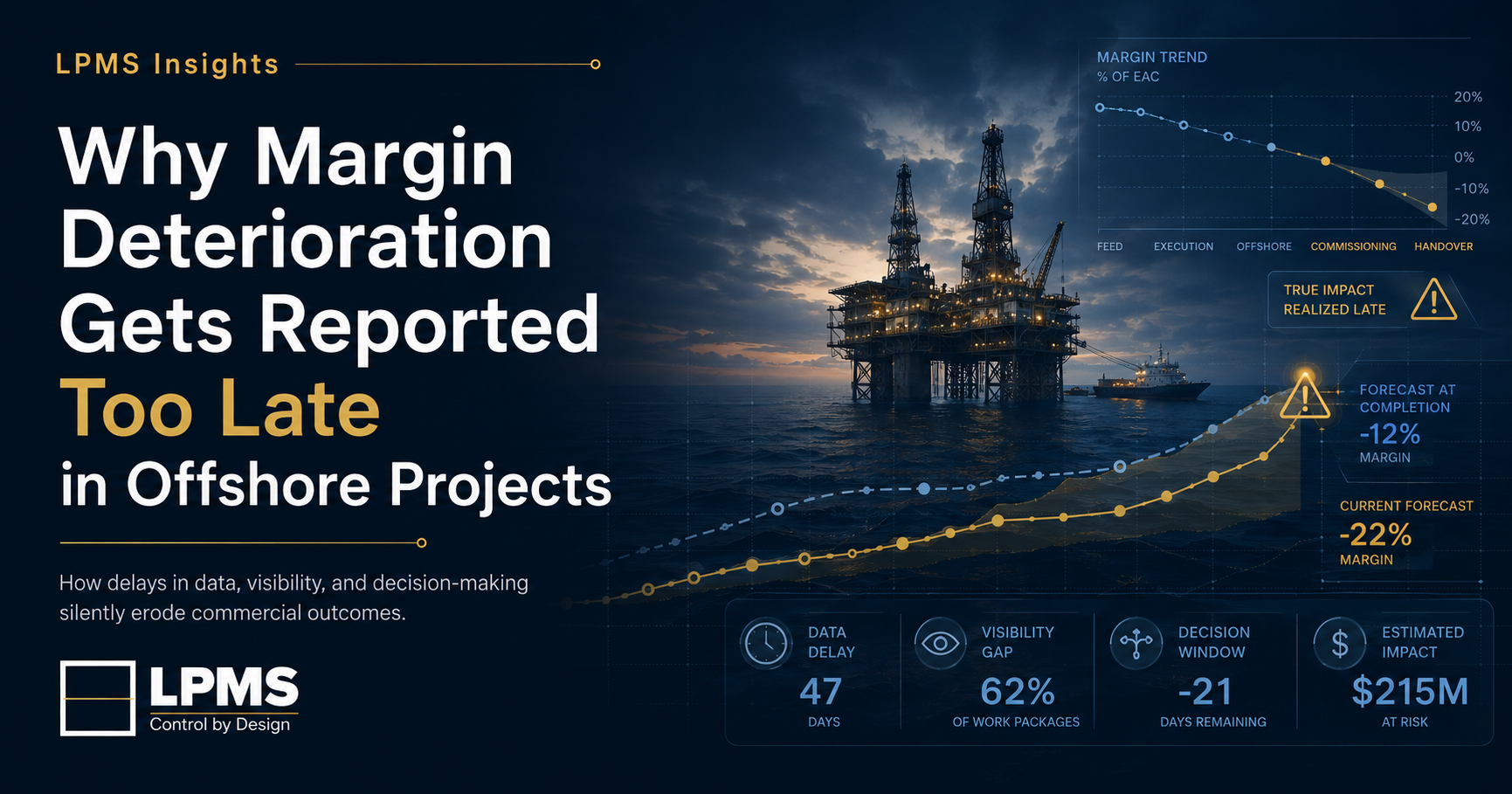
In offshore programs, margin rarely collapses without warning.
More often, it deteriorates quietly, incrementally, while remaining mathematically visible.
The data exists.
The signals are present.
Recognition is delayed.
Across offshore contracting environments, margin erosion is typically not a surprise event. It is a deferred acknowledgment.
And in capital-intensive marine programs, that deferral has consequences.
Forecasting as Governance
Forecasting in offshore projects is often treated as a reporting exercise, which is one reason some project KPIs create false comfort.
In reality, it is a governance mechanism.
Its purpose is not to record performance.
Its purpose is to surface exposure early enough to allow intervention.
Variance is commonly softened before it is recognized:
- Productivity shortfalls are described as temporary.
- Weather inefficiencies are assumed to normalize.
- Subcontractor overruns are framed as isolated.
- Schedule compression is treated as recoverable.
Each individual explanation may appear defensible. Collectively, they alter the expected final outcome.
Recognition is often postponed until structural recovery is no longer feasible.
This distinction is foundational to effective offshore project controls.
The Behavioral Component: Forecast Hesitation
Human judgment under uncertainty follows familiar patterns. In offshore execution environments, this manifests consistently:
- Optimism bias - Overestimating recovery probability.
- Anchoring - Clinging to original bid productivity despite operational drift.
- Loss aversion - Delaying recognition because formalizing deterioration feels like admitting failure.
These are not personal weaknesses. They are predictable human patterns under pressure.
But if forecasting architecture does not compensate for them, bias enters the control system.
And when bias enters the control system, exposure accumulates silently.
The Accountability Misconception
On one offshore program, several project managers resisted engagement with forecast reconciliation and actual cost review. The recurring response was:
"I am not an accountant."
The statement reveals a deeper structural misunderstanding.
Forecast discipline is not accounting.
It is exposure ownership.
Execution leadership does not need to understand ledger mechanics to remain accountable for:
- Productivity assumptions.
- Vessel utilization efficiency.
- Change order timing.
- Resource deployment decisions.
- Recovery feasibility under schedule compression.
When operational leadership distances itself from financial visibility, variance recognition becomes delayed by design.
The forecast shifts from being a management instrument to being a finance report.
In offshore contracting, where daily vessel burn rates are high and charter exposure concentrated, that separation narrows the window for corrective action.
Accountability for margin exposure cannot be delegated to accounting.
It must remain embedded in execution leadership.
How Margin Erosion Develops in Practice
Offshore margin erosion rarely occurs as a single event.
It develops through cumulative drift:
- Vessel productivity trending 5-8% below bid assumptions.
- Persistent minor weather inefficiencies.
- Incremental subcontractor cost creep.
- Procurement slippage under schedule compression.
- Change order delays that erode commercial leverage.
On one marine execution program, vessel productivity trended below bid assumptions for multiple reporting cycles. Each cycle assumed recovery within the existing schedule logic.
By the time structural recovery required resequencing, the operational window had narrowed beyond feasibility.
The deterioration was visible.
Recognition was late.
This pattern aligns directly with the structural drivers described in Why Offshore Projects Lose Margin.
Why Timing Is Amplified Offshore
Offshore programs amplify the cost of delayed recognition because exposure is concentrated:
- Vessel charter costs are fixed and significant.
- Mobilization costs are largely sunk.
- Weather windows are finite.
- Resource reallocation becomes increasingly constrained.
- Commercial leverage declines over time.
This is also why offshore schedule drivers need to be read through sequence viability rather than dates alone. Early recognition preserves optionality:
- Resequencing remains viable.
- Mitigation strategies remain credible.
- Commercial dialogue remains proactive rather than reactive.
- Claim supporting documentation develops alongside events rather than being reconstructed under pressure.
Late recognition reduces strategic action to explanation.
In lumpsum and high-charter environments, this difference materially affects outcome.
Forecast Transparency as Commercial Discipline
Early transparency is not pessimism.
It is executive discipline.
Structured forecasting requires:
- Explicit variance decomposition by exposure driver.
- Conservative forward productivity modeling.
- Continuous reassessment of bid assumptions.
- Clear linkage between operational events and forecast adjustments.
- Governance cadence that resists deferment.
This is where structured project intelligence becomes critical, not as a dashboard concept, but as integrated cost-schedule-risk discipline.
Forecast transparency does not create exposure.
It reveals exposure while mitigation remains possible.
Closing Perspective
Offshore projects operate under inherent uncertainty.
Uncertainty does not justify delayed clarity.
When margin deterioration is visible but not formally recognized, the issue is rarely data availability.
It is governance maturity.
For offshore contractors operating under lump-sum exposure and concentrated charter risk, disciplined forecast recognition preserves strategic leverage.
Optionality narrows with time.
Forecast discipline preserves it.