
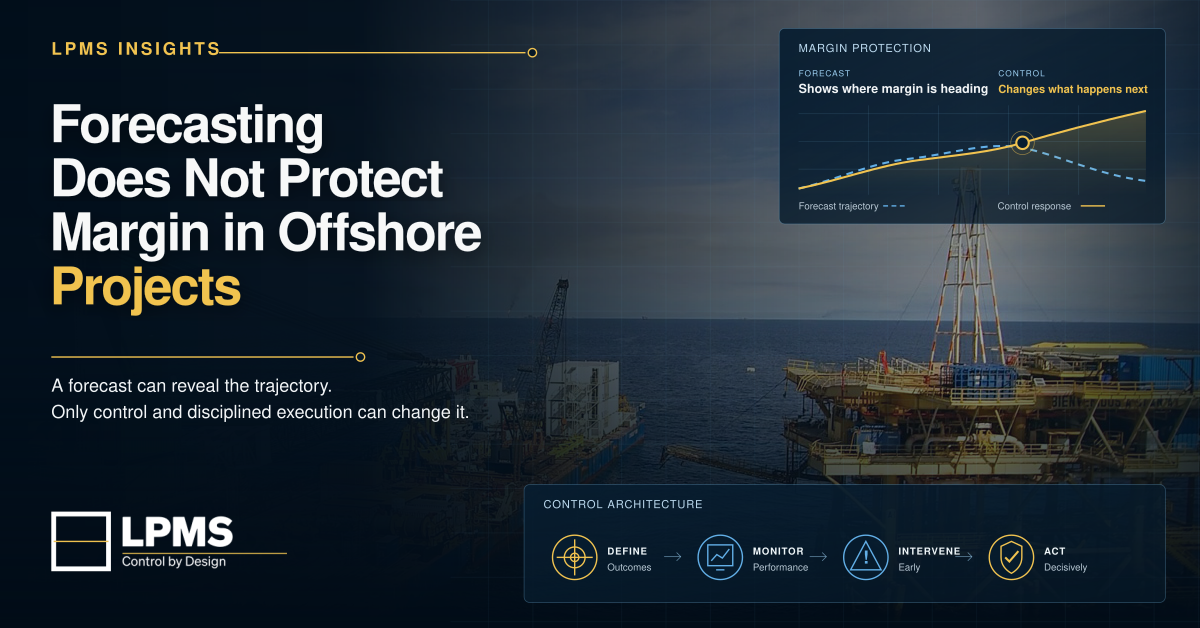
Control Architecture Does
In offshore programs, margin rarely deteriorates because the forecast was missing.
More often, it deteriorates while the forecast exists.
The number is updated.
The exposure is visible.
Control is assumed.
But forecasting and control are not synonymous.
Forecasting records position.
Control constrains trajectory.
The distinction is structural and foundational to effective offshore project controls.
Forecasting as Reporting
In many offshore environments, forecasting becomes a structured update cycle.
Numbers are revised.
Schedules are adjusted.
Assumptions are annotated.
But the underlying control logic remains unchanged.
The forecast reflects the project's current position, yet it does not enforce discipline around:
- Baseline integrity.
- Variance attribution.
- Assumption drift.
- Reconciliation discipline.
- Exposure ownership.
The output exists.
The control system does not.
This is where deterioration begins, not in the spreadsheet, but in the architecture surrounding it.
As explored in Why Offshore Projects Lose Margin, margin erosion is rarely dramatic. It develops structurally when control mechanisms are misaligned.
Baseline Integrity as a Control Anchor
Forecast control begins at contract award.
The As-Awarded position must function as a fixed reference point, not a fluid estimate.
If the baseline is reinterpreted early, modified informally, or softened to accommodate early execution friction, every subsequent variance discussion becomes subjective.
Without a stable anchor, forecasting turns interpretive.
In disciplined offshore control environments, the baseline:
- Mirrors the commercial handover precisely
- Separates base cost from contingency
- Preserves bid productivity assumptions
- Documents embedded risk logic
The baseline is not a starting estimate.
It is the structural reference against which exposure is measured.
Once that reference erodes, governance weakens proportionally, often long before deterioration becomes formally visible in reporting.
Spread-Level Control vs. Summary-Level Visibility
Offshore projects do not execute as aggregated entities.
They execute through spreads:
Vessels.
Dive teams.
Survey spreads.
Fabrication phases.
Engineering packages.
Exposure develops at spread level long before it appears in summary-level reporting.
When forecasting is performed only at consolidated cost-sheet level, deterioration remains statistically visible but operationally abstract.
Control requires daily visibility at the operational interface, where vessel utilization efficiency, productivity assumptions, subcontractor performance, and downtime drivers originate.
Summary reporting reflects reality.
Spread-level tracking shapes it.
This alignment between operational drivers and financial visibility sits at the core of structured project intelligence.
Reconciliation as Discipline
Forecast drift rarely occurs because data is unavailable.
It occurs because reconciliation is incomplete.
A mature control structure separates reconciliation into distinct stages:
First, forecast positions are matched against issued commitments and invoicing realities. Assumptions are converted into confirmed positions.
Second, actuals posted in ERP systems are cross-validated against forecast logic. Misallocations, timing differences, and accrual distortions are surfaced explicitly.
This dual-layer reconciliation prevents quiet deviation.
Without it, the forecast gradually absorbs variance without structured explanation.
The number changes, the exposure narrative does not.
This is often the precursor to the delayed recognition patterns examined in Why Margin Deterioration Gets Reported Too Late in Offshore Projects.
Variance Without Categorization
Variance recognition is not sufficient.
Variance must be attributed.
Offshore deterioration develops through identifiable structural drivers:
- Weather-driven quantity variance.
- Operational schedule drift.
- Pricing deviation.
- Scope expansion.
- Items not captured in the original baseline estimate.
Some organizations refer to this final category informally as "Stuff We Forgot To Include."
The terminology is less important than the discipline behind it.
Every deviation must be classified into a defined structural driver.
When variance is recorded without attribution, exposure analysis becomes descriptive rather than diagnostic.
Categorization is not administrative.
It informs contingency calibration, bid discipline, and executive risk posture.
If variance cannot be explained structurally, forecasting remains reactive.
Weekly Reset as Governance Cadence
Forecasting is not cumulative storytelling.
It is a recurring control cycle.
After each reporting interval, the current forecast becomes the new reference point. Variances are reset. Commentary is cleared. Assumptions are restated.
This reset enforces intellectual honesty.
Without it, narrative layers accumulate. Historical variance blends with current exposure. Control clarity degrades over time.
In capital-intensive marine programs, where daily vessel burn rates are high and charter exposure concentrated, this clarity preserves optionality.
Forecasting and Behavioral Neutrality
Forecast architecture must compensate for structural human bias.
Optimism bias affects recovery assumptions.
Anchoring sustains original productivity expectations despite drift.
Loss aversion delays formal acknowledgment of deterioration.
If forecasting systems do not structurally require explicit forward modeling adjustments, particularly under productivity underperformance, bias remains embedded in projection.
Exposure accumulates quietly.
Control systems exist precisely to neutralize predictable bias.
Forecast transparency is not pessimism.
It is disciplined forward modeling.
Forecasting as a Closed-Loop System
The forecasting cycle does not conclude at project completion.
Variance decomposition must inform future bid logic.
Weather contingency calibration.
Mobilization assumptions.
Productivity modeling.
Customs clearance exposure.
Subcontractor pricing reliability.
Omitted cost identification patterns.
If these are not recalibrated through structured lessons learned, organizations institutionalize optimism rather than knowledge.
Control architecture is circular:
Bid logic informs execution.
Execution variance informs bid logic.
Without that loop, forecasting remains procedural rather than strategic.
The Structural Distinction
Forecasting produces a number.
Control architecture preserves optionality.
In offshore programs characterized by:
- Concentrated charter exposure
- Fixed mobilization cost
- Finite weather windows
- Lump-sum risk concentration
- High daily burn rates
The timing of recognition determines available decision space.
Early recognition preserves resequencing feasibility.
Preserves commercial leverage.
Preserves mitigation credibility.
Late recognition reduces management action to explanation.
Forecasting alone does not prevent that shift.
Control architecture does.
Closing Perspective
Margin erosion in offshore projects rarely emerges suddenly.
It develops incrementally:
A slight productivity underperformance.
A persistent standby pattern.
A procurement slippage.
A delayed variation order.
A minor pricing deviation.
Individually defensible.
Collectively structural.
The purpose of forecasting is not to record this development.
It is to constrain it while strategic options remain viable.
In offshore contracting, the distinction between reporting and governance is material.
Forecasting is a tool.
Control architecture is protection.
Only one preserves margin under uncertainty.