
Additional scope is never just additional scope.
In live execution, management can usually see the extra vessel days, the added personnel, the new equipment, the revised revenue line, or the priced variation. Those items are tangible. They enter the commercial conversation quickly because they look like discrete additions to the job.
The harder loss sits elsewhere.
When additional scope interrupts a working sequence, redirects a spread, shifts the team into worse operating conditions, or forces a return to the original scope under a less efficient basis, the damage does not stay inside the added work. It reaches back into the base scope and weakens the productivity the original plan depended on.
That is where margin often starts to leak without drawing enough management attention.
The extra work may be recognized, but the lost productivity often is not.
The distinction matters because these are not the same commercial event. One is visible and relatively easy to price. The other is a decline in execution efficiency across work that management still tends to regard as ordinary base scope.
That second loss is where forecasts become vulnerable.
The Loss Sits Between Change and Delay
Senior teams are usually alert to two categories of commercial movement.
They look for formal changes, because those can usually be priced, negotiated, instructed, or at least documented. They also look for visible delay, because delay starts to affect completion dates, vessel exposure, notices, client pressure, and revenue timing.
Lost productivity caused by additional scope often sits between those two.
The operation is still moving. Work is still being completed. The spread has not necessarily stopped. The forecast may even improve on paper because added scope and associated revenue have been brought in. Yet the underlying prosecution rate on the original work has deteriorated.
That is a dangerous place commercially because it creates the appearance of control while efficiency is already being diluted.
The mechanism is straightforward.
A working operation develops rhythm. Equipment interfaces settle down. Crews learn the conditions. The supervisory team sharpens its judgment. Reporting becomes more stable. Short-cycle decisions improve because the team is working inside a familiar sequence.
Additional scope breaks that continuity.
The disruption may come from redirection of key assets. It may come from switching work fronts. It may come from introducing a second priority that competes for vessel time, management attention, or specialist resources. It may come from moving into a location where visibility, current, congestion, or access conditions are materially worse. It may come from returning to the original work after the team has already been pulled through a different operating pattern.
At that point, the extra work is no longer just extra work. It has changed the basis on which the original work is being prosecuted.
Why This Is Missed in Live Project Control
There is a practical reason this loss is often under-seen.
Forecast systems are usually better at capturing additions than degradations. A new instructed scope can be assigned a code, priced, tracked, and rolled into forecast logic. A deterioration in base-scope productivity is messier. It sits across multiple lines. It may not present as one single event. It may be explained away as local conditions, temporary inefficiency, or normal operational variation.
By the time the pattern becomes undeniable, margin has usually already moved.
This is one of the recurring weaknesses in project controls. The commercial structure is often prepared to recognize more work. It is less prepared to expose the reduced earning quality of the work that was already there.
That leaves management with an incomplete picture. The added scope is visible. The weakened performance of the original scope stays partly buried inside lower production rates, stretched supervision, less efficient asset deployment, and a forecast that still assumes too much continuity.
That gap matters because it creates false comfort. The project team can point to ongoing progress, recognized scope growth, and an active commercial file. None of that proves the original work is still being executed on the basis the margin depended on.
Scope Switching Is a Productivity Event
Additional scope becomes commercially dangerous when it changes how the team has to work, not only what the team has to do.
That change can take several forms.
The first is asset redirection. A vessel, crane, survey package, or specialist team that was meant to keep the main sequence moving is pulled into work that was not part of the original production logic. Even when that decision is justified, the base sequence loses continuity.
The second is work front deterioration. The team may still be performing, but in worse current, lower visibility, tighter access conditions, heavier congestion, more difficult geometry, or under a more constrained method. The headline still says progress. The earned efficiency underneath it is weaker.
The third is management dilution. Additional scope pulls not only hardware, but also leadership capacity. Supervisory focus, planning effort, client interface time, subcontractor coordination, and daily decision energy get spread thinner. This rarely appears neatly in a cost code, but it changes performance.
The fourth is re-entry loss. Once the team has been pulled out of its original sequence, going back into the base scope is rarely neutral. Conditions may have changed. The easier work may already be gone. The remaining scope may now sit in less favorable locations or under more pressured timing. The job resumes, but under a poorer operating basis.
This is why the phrase additional work can be commercially misleading. It suggests accumulation. The bigger effect is often interference.
Middle East: When Extraordinary Work Changes the Basis of the Spread
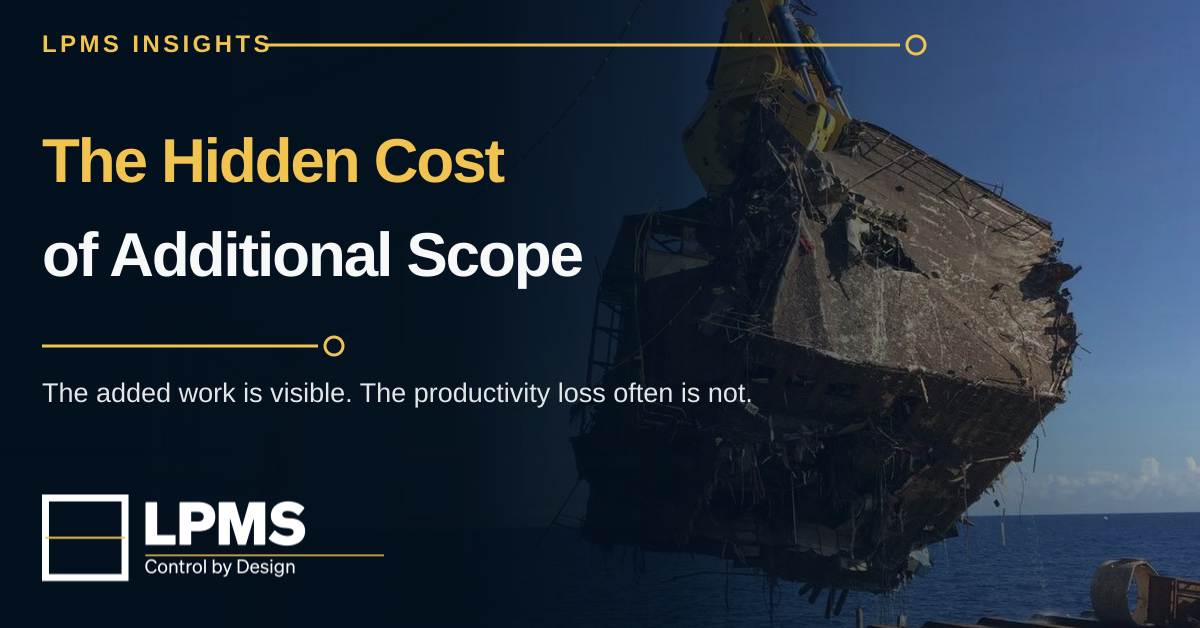
The middle eastern wreck removal case is useful because it shows how extraordinary scope can alter the operating basis of the whole job, not just add work beside it.
The original operation was built around a defined spread and a planned removal sequence. Once extraordinary work emerged outside that expected basis, the commercial and operational assumptions around the spread began to change. The issue was no longer only whether the added work would be recognized. It was whether the original production logic of the job could still hold once the operation was being carried under different conditions, with a different intensity, and over a longer period.
That is the important point.
Extraordinary work does not need to stop the original job to weaken it. It only needs to change how the spread is being used, how long it remains committed, how management attention is allocated, and how much continuity the planned work retains.
In this example, the commercial structure already hinted at that reality. Once the work moved beyond the original expected basis, the economics of the spread were no longer governed by the same assumptions. Duration extended. Third-party input had to be reconsidered. The operating intensity of the planned sequence weakened. The cost of time continued.
That is where the productivity effect becomes commercially important.
The damage is not confined to whether the extraordinary scope is compensable. The deeper issue is that the original work is no longer being prosecuted on the basis the margin was built on. A register can capture the fact that something additional happened. It does not automatically capture what that addition did to the productivity of everything around it.
Borssele: When the Work Continues Under a Weaker Operating Basis
The Borssele OWF Cable Route ID and Clearance shows the second pattern more clearly: the work keeps moving, but under conditions that steadily weaken the productivity of the original scope.
The issue was not a dramatic stop. It was a gradual deterioration in the basis on which targets could be prosecuted. As the campaign moved into more difficult areas, current and visibility became materially worse than in earlier work. Progress continued, but at a slower and less efficient rate. Later, the operation also had to absorb work that interrupted the original sequence and pushed the vessel into busier and less favorable locations.
That combination matters because productivity loss does not always arrive through shutdown. It can come through worse operating conditions, broken continuity, and a sequence that is no longer being executed where and how it was first assumed.
That is what Borssele illustrates. The vessel remained active. Work was still being completed. Additional tasks were still being taken on. But the earning quality of the original work had weakened because the campaign was now operating in poorer visibility, more difficult locations, and a fragmented sequence worse than the original production basis assumed.
This is exactly the kind of pattern management can under-read. There is visible activity, recognized scope movement, and continuing progress. Yet the base-scope earning mechanism has already softened. The operation is producing, but under a weaker operating basis than before.
No dramatic stop is required for margin to erode.
The loss comes through reduced prosecution rate, harder conditions, more fragmented execution, and the fact that returning to the original work front does not restore the original production basis. Often the team returns to what remains, and what remains is harder.
That is how additional scope damages margin even when it is recognized.
Forecast Integrity Is Usually Where the Truth Gets Blurred
This is not only an execution issue. It is a forecasting issue.
A forecast that captures added revenue and direct added cost but does not adjust the productivity assumptions on the remaining original work is giving management an incomplete commercial picture. It may still look disciplined. It may still reconcile arithmetically. It may still show movement against visible events.
That is not enough.
Forecast integrity depends on whether the operating basis has changed. If the sequence has been broken, if the work front has deteriorated, if key assets have been redirected, or if the team has returned to the base scope under weaker conditions, then the remaining work cannot be forecast as though continuity still exists.
This is where many projects become too optimistic without sounding reckless. The formal change is in the number. The productivity damage is left in the narrative.
That is a management visibility failure.
Senior leaders do not need every local operational detail. They do need to know when recognized additional scope has started to impair the earning quality of the original work. That should trigger a different level of commercial scrutiny, because the risk has moved from scope growth into margin dilution.
This is also where better project intelligence starts to matter. The business does not only need visibility on what was added. It needs visibility on what the addition did to the productivity of the work that was already there.
The Discipline This Requires
The practical question is not whether additional scope should be tracked. Of course it should.
The better question is whether management is being shown the secondary productivity effect on the base work.
That requires a few disciplines.
First, the team must separate recognized extra work from degraded performance on the original scope. Those are different commercial signals, and they should not be blended into one broad story of change.
Second, operational reporting has to record when the basis of execution has changed. Harder sectors, worse visibility, different work locations, redirected assets, broken sequence, diluted supervision, or re-entry into residual harder work should all be treated as forecast-relevant conditions.
Third, forecast reviews need to test remaining productivity, not just added quantities and revenue. Once continuity has been broken, historical assumptions are weaker by definition.
Fourth, project leadership needs to resist the temptation to treat continued activity as evidence that the original margin logic still holds. Movement is not the same as efficiency.
That is where commercially serious execution discipline separates itself from procedural project administration.
Closing Perspective
Additional scope is often discussed as though the main question is whether the extra work will be paid.
That is only part of the picture.
In live execution, the greater commercial danger is often that added scope weakens the productivity of the original work without ever presenting as a clean delay or a disputed event. The operation continues. The spread stays busy. Progress is visible. Management sees recognizable additions. Meanwhile the base job is being completed more slowly, under worse conditions, or with less continuity than the estimate assumed.
That is how margin slips through the middle.
The loss does not always announce itself as a headline event. It often arrives as reduced prosecution rate, broken rhythm, redirected assets, diluted management attention, and a forecast that recognized the new work faster than it recognized the damage done to the old.
Senior leaders should watch that space carefully.
Because once additional scope starts changing the operating basis of the original work, the commercial question is no longer only what was added.
It is what the team is now earning less efficiently than before.